Is India's New Industrial Revolution Real?
“If there are no major changes in the future, India will become a new manufacturing centre in the world.”
For information and education only. Not investment advice or research.
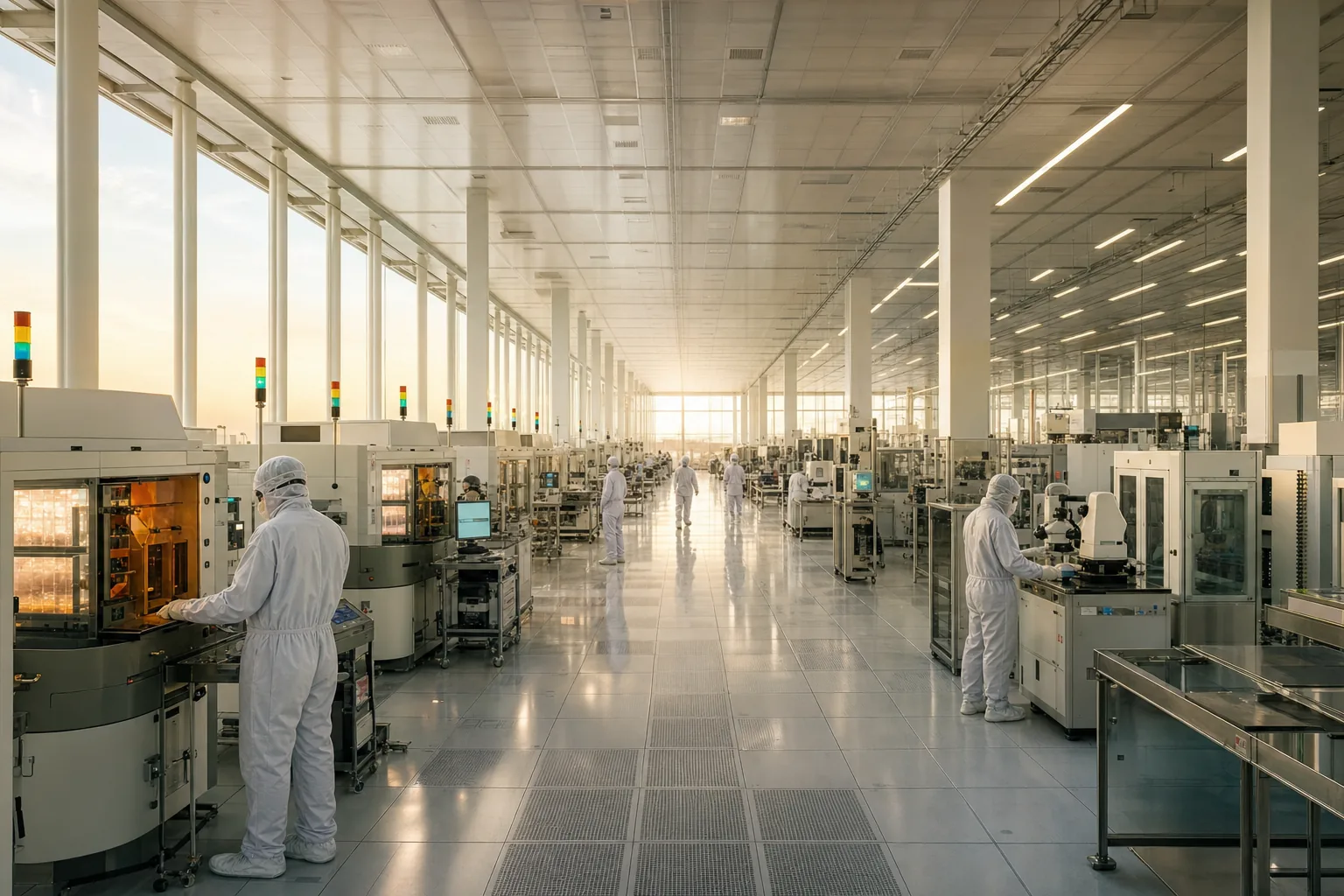
A new chip plant in Gujarat used three and a half Eiffel Towers’ worth of steel in its cleanroom alone.
The plant belongs to Micron, the American memory-chip maker, and opened in February 2026 at Sanand, near Ahmedabad. It packages and tests memory chips. Micron’s chief executive, Sanjay Mehrotra, made the Eiffel Tower comparison ahead of the opening.
Named as an illustration, not a recommendation to buy or sell.
On the other side of the country, Google is building a $15 billion AI hub in Visakhapatnam, on the Andhra Pradesh coast, between 2026 and 2030. UNCTAD, the United Nations trade body, ranked it the largest new foreign investment project announced anywhere in the world in 2025.
Projects like these have started a debate about whether India is in a new industrial revolution.
The answer depends on which industries you look at.
Industries Growing Faster Than the Economy
A handful of Indian industries are growing several times faster than the economy around them. They are defence, mobile phones and electronics, data centres, aircraft parts and solar manufacturing.
Each has its own engine. Defence is a government priority: since 2020 the Ministry of Defence has listed equipment the armed forces must buy from Indian makers, and it now pushes exports too. Phones and electronics grew on a production-linked incentive scheme launched in 2020, and on brands such as Apple moving part of their production out of China.
Data centres are pulled by cloud computing and artificial intelligence, and by rules that keep some data, such as payments data, inside India. Aircraft parts ride a global shortage: Airbus and Boeing have more orders than they can build, and in 2023 Air India and IndiGo alone ordered close to 1,000 planes.
Solar factories grew behind import duties and a government list of approved panel makers.
Two forces run through all of them. Foreign companies want a second base outside China, and the government offers incentives and, in some industries, requires local production.
The pace shows in the numbers. Defence exports are up 4.6 times in five years and electronics exports 4.3 times, while the economy as a whole grew about 1.8 times in rupee terms.
Hindustan Aeronautics (HAL), the state-run aircraft maker, now has orders worth about eight years of its revenue.
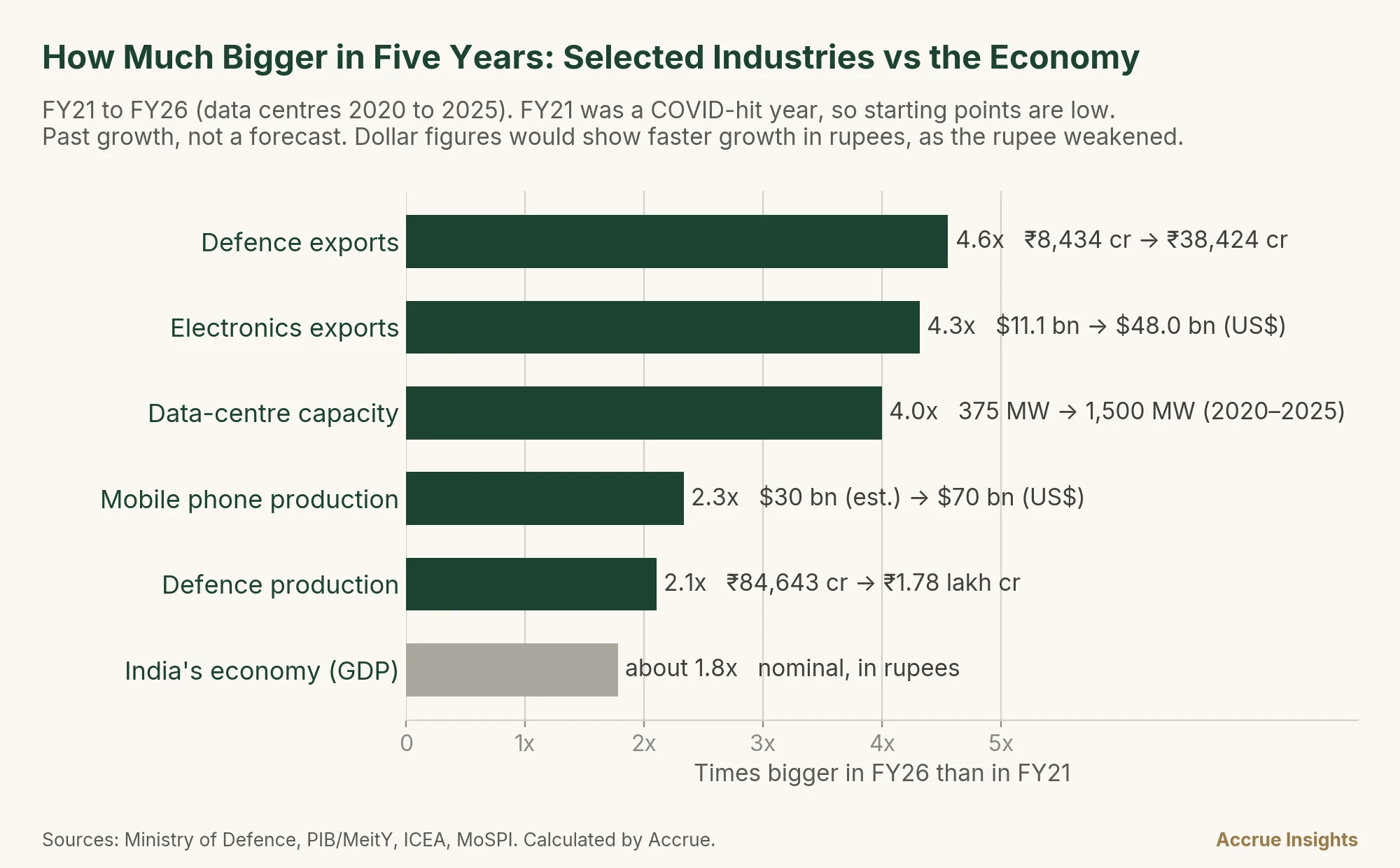
From FY21 to FY26 defence exports grew 4.6 times and India’s economy 1.8 times.
From FY21 to FY26, every industry on the chart outgrew the economy, defence production only narrowly. FY21 was a COVID-hit year, which flatters any growth measured from it.
Part of that speed comes from a small start. Defence exports were just ₹686 crore in FY14. Growth from a base that small is not a pace to assume for the next five years.
A Few at Scale, Most Still Small
Fast growth is one half of the picture. Size is the other, and here India’s new industries split in two.
Two have reached world scale. India now makes 18 per cent of the world’s smartphones, and its factories can make 14 to 17 per cent of the world’s solar panels.
Scale in phones is still mostly assembly. India adds about 22 to 23 per cent of a phone’s value, up from about 15 per cent when the industry started out, according to the Electronics Ministry’s secretary.
The ministry’s stated aim is 35 to 40 per cent, though it has given no date; China is already at 38 to 40 per cent, according to the industry body ICEA.
The rest are still small against the world. Data centres, electronics exports, space and aircraft parts each hold one to two per cent of their global market. Shipbuilding and battery cells hold less than a tenth of one per cent.
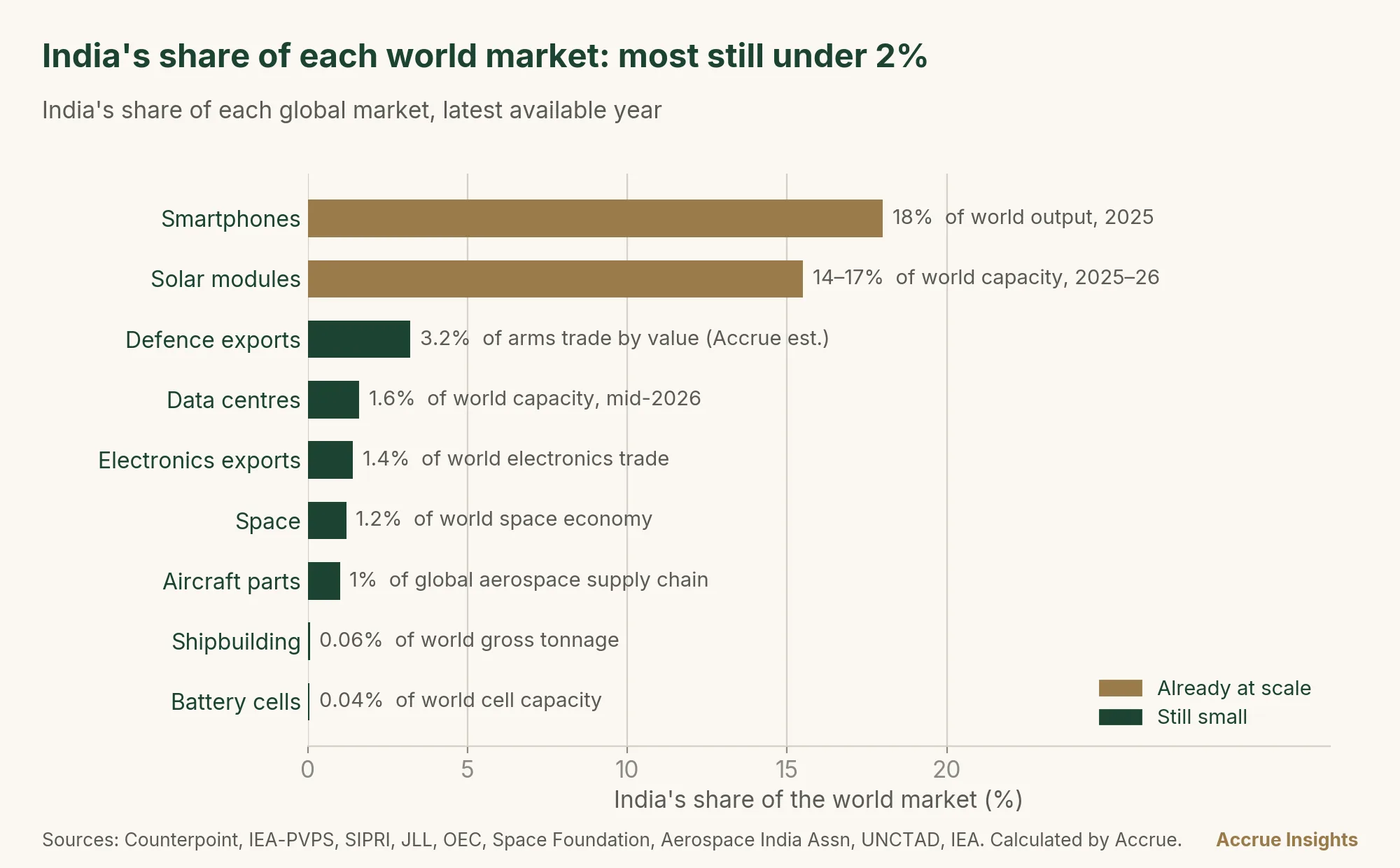
India makes 18% of the world’s smartphones but builds 0.06% of its ships.
Seven of the nine industries on the chart hold under 4 per cent of their world market.
Read more below.
Read more: Defence
Defence covers weapons, aircraft, ships and electronics for the armed forces. India’s own military is the main buyer, and the government’s preference for Indian makers is what built the industry.
Production has roughly doubled in five years, to ₹1.78 lakh crore in FY26, and private companies now make about 45 per cent of exports. Abroad, India is still a small seller: about 3 per cent of world arms exports by value on our estimate, and under 0.3 per cent by volume, according to SIPRI.
Read more: Phones and electronics
Phones carry India’s electronics story. About one in four iPhones is now made in India, and phones make up most of the $48 billion of electronics India exported in FY26.
What India adds is still mostly assembly. It holds about 1.4 per cent of world electronics trade, against Vietnam’s 3.1 per cent and China’s 31 per cent. The parts inside the phone are still largely imported.
Read more: Aircraft parts
Indian factories make parts for Airbus and Boeing planes that are assembled elsewhere. Together the two companies buy about $3 billion a year from Indian suppliers, around 1 per cent of the global aerospace supply chain.
The pull is their backlog. Both makers have years of orders to fill, and Airbus aims to buy $2 billion a year from India before 2030.
Read more: Data centres
A data centre is a building full of computers that store and process data for cloud and technology companies. India’s capacity has roughly quadrupled since 2020, to about 1.5 gigawatts in 2025, according to the Electronics Ministry.
That is still under 2 per cent of the world total; the United States holds about half. JLL, the property adviser, projected in 2026 that India would reach about 6 gigawatts by 2029.
Read more: Chips
India imports more than 90 per cent of the chips it uses and makes almost none. Its first plants are only now being built.
Micron’s Sanand plant packages and tests chips; it does not make them. The first plant that will make them, a fab costing about $11 billion, is being built at Dholera in Gujarat by Tata and Taiwan’s PSMC.
Read more: Solar
Solar is the industry that scaled first. India could make 2.3 gigawatts of panels a year in 2014; by June 2026 it could make 233 gigawatts.
The harder part is the cell inside the panel. Cell capacity is about one-sixth of panel capacity, so many Indian panels are still built on imported cells.
Read more: Space
India’s space economy is worth about $8.4 billion, roughly 1.2 per cent of the world’s. Most of that value comes from services that run on satellites, such as communication and mapping.
Making satellites is about a quarter of it, according to an ISpA-EY study. Private companies are only now moving from early launches to commercial work.
Read more: Shipbuilding
Shipbuilding is starting from almost nothing. India builds about 0.06 per cent of the world’s ships; China, South Korea and Japan build nearly all the rest.
In September 2025 the government approved a ₹69,725 crore package to finance shipyards. It has yet to show up in output.
Read more: Battery cells
Battery cells, the heart of electric vehicles and power storage, have barely started. India holds about 0.04 per cent of world capacity; China holds more than 80 per cent.
The government’s incentive scheme has delivered about 2.8 per cent of its 50 gigawatt-hour target, according to IEEFA.
Small size cuts both ways. An industry with 1 per cent of its world market has room to grow, but little say over the prices, rules and buyers it depends on.
Trade rules show it. The US takes about a fifth of India’s goods exports, and it has changed its duties on Indian goods at least five times since April 2025.
Indian solar panels face a far steeper wall: in September 2026 the US Commerce Department set duty rates of more than 100 per cent on them, with a final vote by the US International Trade Commission due on 14 October.
Europe has added its own rule. Since January 2026 its carbon border tax charges importers of steel and aluminium for the carbon released in making them. An ICRIER study estimates it could cut Indian steel exports to Europe by 24 per cent.
For an industry that sells into a few markets, one rule abroad can change the outlook.
From Assembly to Engineering
The kind of work India does is changing too, from assembling products to engineering them. The clearest sign is where the world’s aircraft and engine makers now place their engineers and their most demanding work.
Boeing says its India engineering team, more than 6,000 people, is the largest it has outside the United States. In October 2024 Airbus and Tata opened India’s first private-sector final assembly line for military aircraft, building C295 transport planes at Vadodara. In November 2025 Safran, the French engine maker, announced a centre in Hyderabad to repair LEAP jet engines.
The shift reaches beyond aircraft. Engineering exports have grown from about $70 billion in FY15 to $122.43 billion in FY26. Global companies, most of them foreign, now run 2,117 capability centres in India, employing 2.36 million people in technology, engineering, product and operations work, according to Nasscom and Zinnov. In the largest centres, about 43 per cent of staff work in engineering and research.
The move is real, and it is early. Electronic components were only 9 per cent of India’s electronics production in FY24, against about 42 per cent worldwide. The C295 is an Airbus design and the LEAP a Safran engine: India builds and repairs them, and the designs stay abroad.
Young Liu’s forecast in 2023 came with a condition: no major changes.
Three years on, trade rules have changed more than once.
The plants, the engineering teams and the export orders have kept coming so far.

✓ You have finished this 7-minute read
Team Accrue · Accrue Insights
Thank you for reading. We write for investors who want the whole picture, the opportunity and the risk.
This article discusses general market and macroeconomic trends only. It does not recommend, endorse, or provide advice on any specific security, mutual fund scheme, or investment strategy. Companies named are illustrations only, not recommendations. See Accrue's full regulatory disclosures below.
Is India’s new industrial revolution real?
Defence exports are up 4.6 times in five years, from ₹8,434 crore in FY21 to ₹38,424 crore in FY26. Electronics exports are up 4.3 times over the same five years. Data-centre capacity grew about 4 times between 2020 and 2025, according to the Electronics Ministry.
Which Indian industries are growing fastest?
Between FY21 and FY26, defence exports grew 4.6 times and electronics exports 4.3 times. Data-centre capacity grew about 4 times between 2020 and 2025. Over the same five years India’s economy grew about 1.8 times. FY21 was a COVID-hit year, so starting points were low.
How big are these industries compared with the rest of the world?
Most hold a small share of their world market. India holds about 1.4 per cent of world electronics exports, about 1.6 per cent of world data-centre capacity, about 1.2 per cent of the world space economy, 0.06 per cent of world shipbuilding and about 0.04 per cent of world battery-cell capacity. Smartphones (18 per cent of world output) and solar modules (14 to 17 per cent of world capacity) are larger.
Why are these industries growing so fast?
Most started from a small base, so early orders produce large percentage increases. Defence exports were ₹686 crore in FY14 and ₹8,434 crore in FY21, about 12 times as much.
What could slow India’s new industries down?
US duties on Indian goods have changed at least five times since April 2025. In September 2026 the US Commerce Department set duty rates of 123.04 per cent (anti-dumping) and 126.09 per cent (countervailing) on Indian solar cells and modules; the US International Trade Commission votes on them on 14 October. Europe’s carbon border tax has applied to steel since January 2026. The US takes about 20 per cent of India’s goods exports.
Is India moving into high-end engineering work?
Engineering exports are up 1.7 times in eleven years, from about $70 billion in FY15 to $122.43 billion in FY26. Boeing says its India engineering team, of more than 6,000 people, is its largest outside the US. India adds about 22 to 23 per cent of a phone’s value, according to the Electronics Ministry, against 38 to 40 per cent in China, according to the industry body ICEA.

Read next
Crude Oil Rise to $110: Impact on Nifty, Rupee, and the Indian Economy
Brent crude surpasses $110 amid simultaneous global supply shocks. See how this impacts the Nifty 50, pushes the rupee near 96, and hits India’s economy.
Read the article →Sources (50)
- Ministry of Defence / PIB — defence exports FY26 (₹38,424 crore; private sector 45%).
- Ministry of Defence — defence production FY26 (₹1.78 lakh crore), via DD India.
- PIB / MeitY — electronics production and exports FY26.
- PIB — electronics exports FY21.
- ICEA — mobile phone production FY26, via Business Standard.
- PIB / MeitY — India data-centre capacity 2020 to 2025.
- JLL — India data centres, 2026.
- JLL — global data-centre capacity outlook (Americas about half of world capacity).
- SIPRI — Trends in International Arms Transfers, 2025.
- Space Foundation — The Space Report 2026 (global space economy).
- IEA — Global EV Outlook 2026, batteries.
- IEEFA — battery-cell incentive scheme progress.
- UNCTAD — Review of Maritime Transport 2025 (shipbuilding shares).
- UNCTAD — World Investment Report 2026 news release (data centres).
- Google — first AI hub in India, $15 billion.
- Micron — opening of Sanand assembly and test facility.
- PIB — India space economy about $8.4 billion (ISpA-EY estimate).
- Airbus — Make in India, March 2026.
- HAL FY26 results and order book, via PSU Watch.
- MoSPI — provisional GDP estimates 2025-26.
- Counterpoint — global smartphone manufacturing, H2 2025.
- IEA-PVPS — Trends in Photovoltaic Applications 2026.
- OEC — world trade in electrical machinery and electronics.
- Foxconn chairman Young Liu, September 2023, via Business Today.
- PIB — US Section 301 duty on India (10%; generic medicines and smartphones exempt), 25 July 2026.
- White House — duty on India for Russian oil removed, February 2026.
- US Supreme Court — Learning Resources v. Trump, 20 February 2026.
- US Commerce Department — final anti-dumping and countervailing duties on solar, September 2026.
- European Commission — Carbon Border Adjustment Mechanism.
- ICRIER study on EU carbon border tax and Indian steel, via Business Standard.
- DD News — India’s trade with the US, FY26 (Commerce Ministry data).
- Boeing — India engineering and R&D team, 19 January 2024.
- PIB — C295 final assembly line, Vadodara, 28 October 2024.
- Safran — expansion in India, 26 November 2025.
- PIB — engineering exports FY26, 8 June 2026.
- Business Today — MeitY Secretary on domestic value addition in phones, 21 August 2026.
- Business Standard — India’s electronics components share.
- PIB — Status of defence exports: ₹8,434.84 crore in FY 2020-21.
- PIB — The Defence Decade (exports ₹686 crore in 2013-14, ₹38,424 crore in 2025-26).
- PIB — Cabinet approves ₹69,725 crore shipbuilding and maritime package, September 2025.
- PV Tech — India solar module capacity about 233 GW (IEEFA/JMK) and cell capacity 36.6 GW (Mercom), 2026.
- White House — proclamation: 100% duty on patented pharmaceuticals, April 2026.
- Zinnov-Nasscom — India GCC Landscape 2026 (2,117 centres, 2.36 million staff).
- Zinnov — five shifts in India’s capability centres, 2025 (about 43% of staff in engineering and research in mega centres).
- Tata — first Indian semiconductor fab at Dholera with PSMC (about ₹91,000 crore).
- ThePrint — NITI Aayog: India imports 90-95% of its semiconductors.
- NPR — Air India orders 470 Boeing and Airbus aircraft, 14 February 2023.
- Business Today — IndiGo orders 500 Airbus A320 aircraft, 19 June 2023.
- Business Standard — India is 1% of the global aerospace supply chain (Aerospace India Association), February 2025.
- Tech Wire Asia — about a quarter of iPhones made in India, March 2026.