How Polarised Is India's Stock Market?
“Whatever you can rightly say about India, the opposite is also true.”

For information and education only. Not investment advice or research.
Ask two investors how their portfolios are doing, and the answers can be diametrically opposite.
The conservative investor, in large-cap funds and the household names of the Sensex, has had a poor run. The aggressive investor, in mid-cap, small-cap and micro-cap funds, has had a much better one.
Now look at your own portfolio. Put the large-cap fund beside the mid-cap fund and the divergence is stark. That is because Indian markets are polarised.
Did Indian Equity Make Money in Five Years? Yes and No
Not much, if you own the Sensex.
Over the last five years the Sensex has delivered an annual return of just over 4%, before dividends, and it is down about 15% this year.
The index is concentrated. Financials and IT together account for about half of the Sensex, and they are the two sectors FIIs have sold hardest since April 2022. Crude oil has been one of this year’s headwinds; we covered its impact in Crude Hits $110: Impact on Nifty, Rupee & India’s Economy.
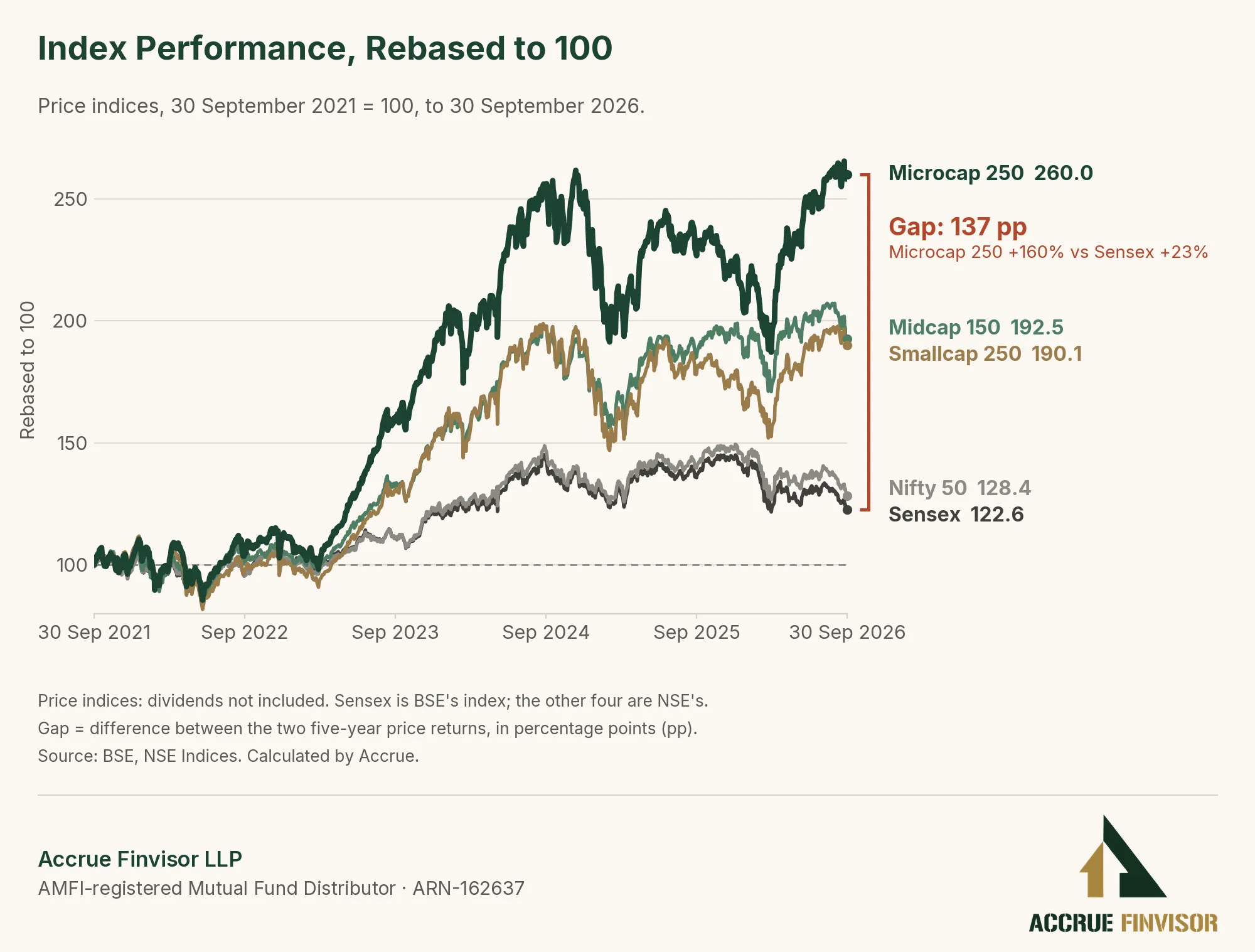
Over five years, the Microcap 250 has outperformed the Sensex by about 137 percentage points.
The other side
Yes, Indian equities have made money in the last five years.
If you own mid, small or micro caps, the period has been strong: the Midcap 150 and Smallcap 250 have each compounded at about 14% a year and the Microcap 250 at about 21% before dividends.
This year, micro caps are up even as the Sensex has fallen. Mid, small and micro-cap indices are near their all-time highs.
Large caps have had a weak five years while mid, small and micro caps have had a strong one.
Are FIIs Selling India? Yes and No
Yes, FIIs are selling at a record pace.
Net FII equity selling reached ₹2.6 lakh crore in the first nine months of this year, more than in any full year since 2002.
The selling is concentrated in the sectors that dominate the large-cap indices. Since April 2022, FIIs have pulled about US$47 billion out of financials, IT and oil and gas alone, and have been net sellers of FMCG, power and autos as well.
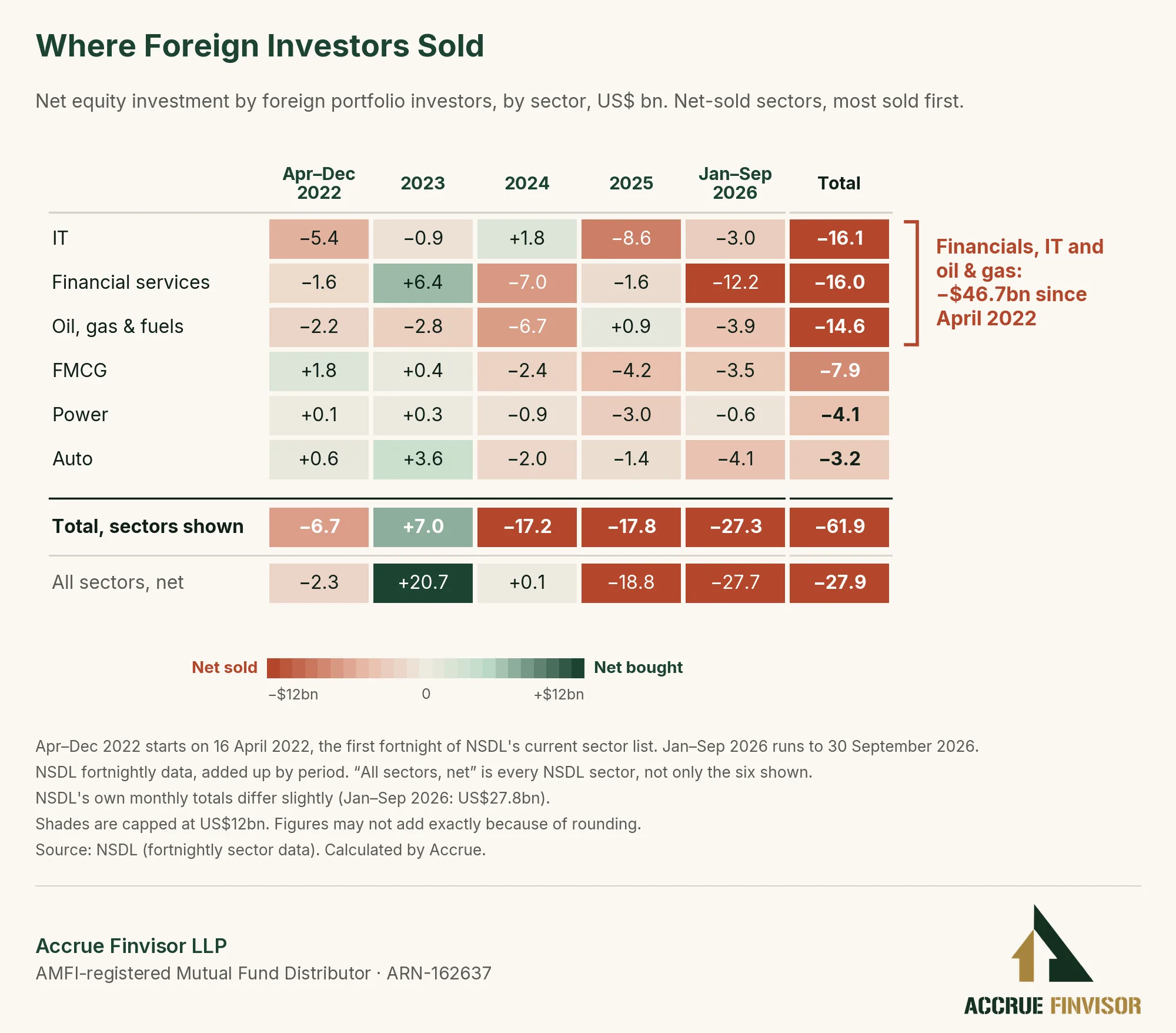
FII selling is concentrated in financials, IT and oil and gas.
The other side
No, FIIs are buying.
Capital goods has been their largest net purchase since April 2022, at about US$12 billion, alongside telecom, consumer services and healthcare. This year they have bought more metals and mining stocks than in any year since 2012.
Capital goods sits at the centre of the manufacturing build-out we examined in Is India’s New Industrial Revolution Real?.
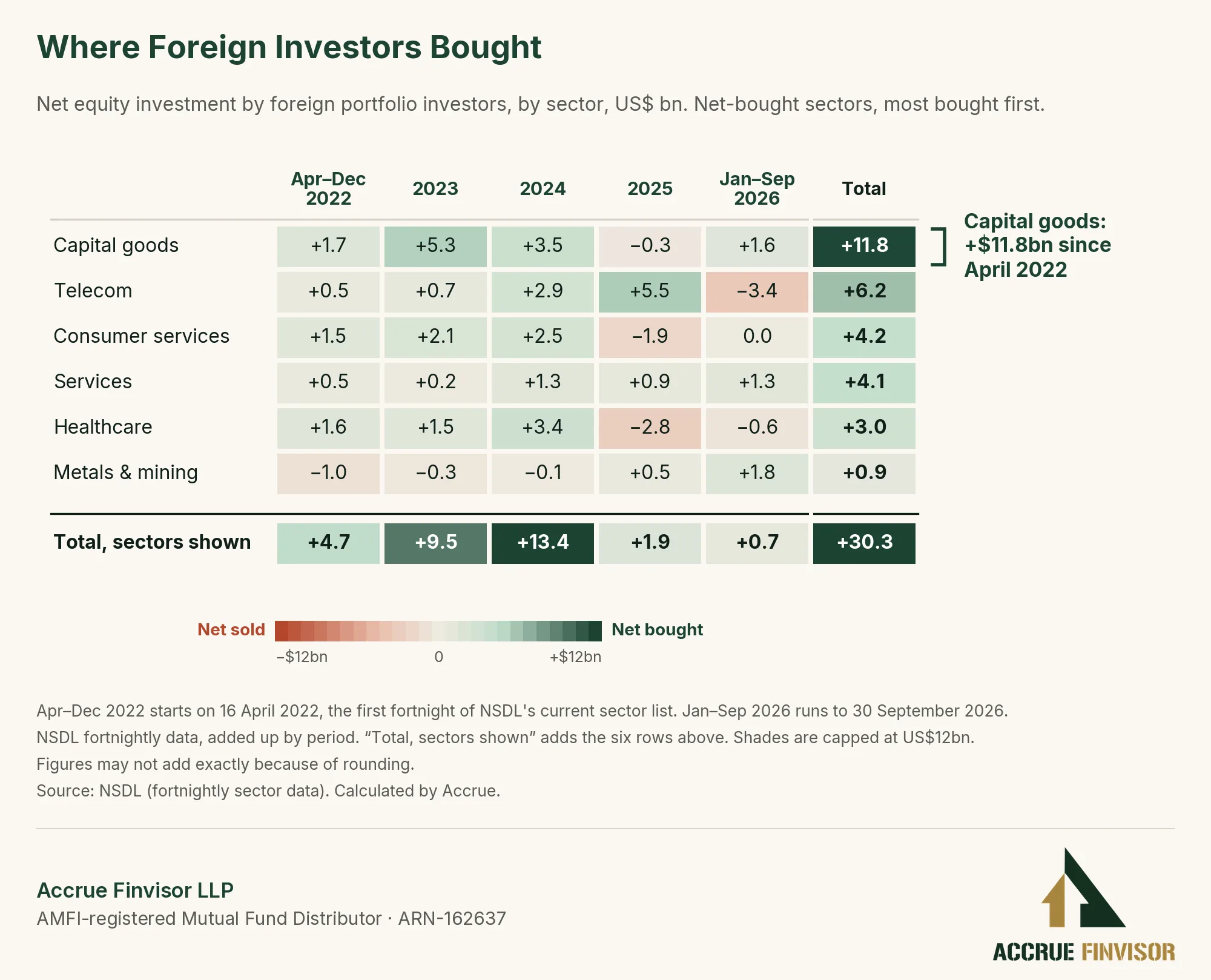
FII buying is led by capital goods.
Is India Cheap or Expensive? Both
The Nifty 50 trades 1.3 standard deviations below its average P/E since 2021.
Over the last five years, Nifty 50 earnings per unit grew by almost 80% while the index rose by less than 30%.
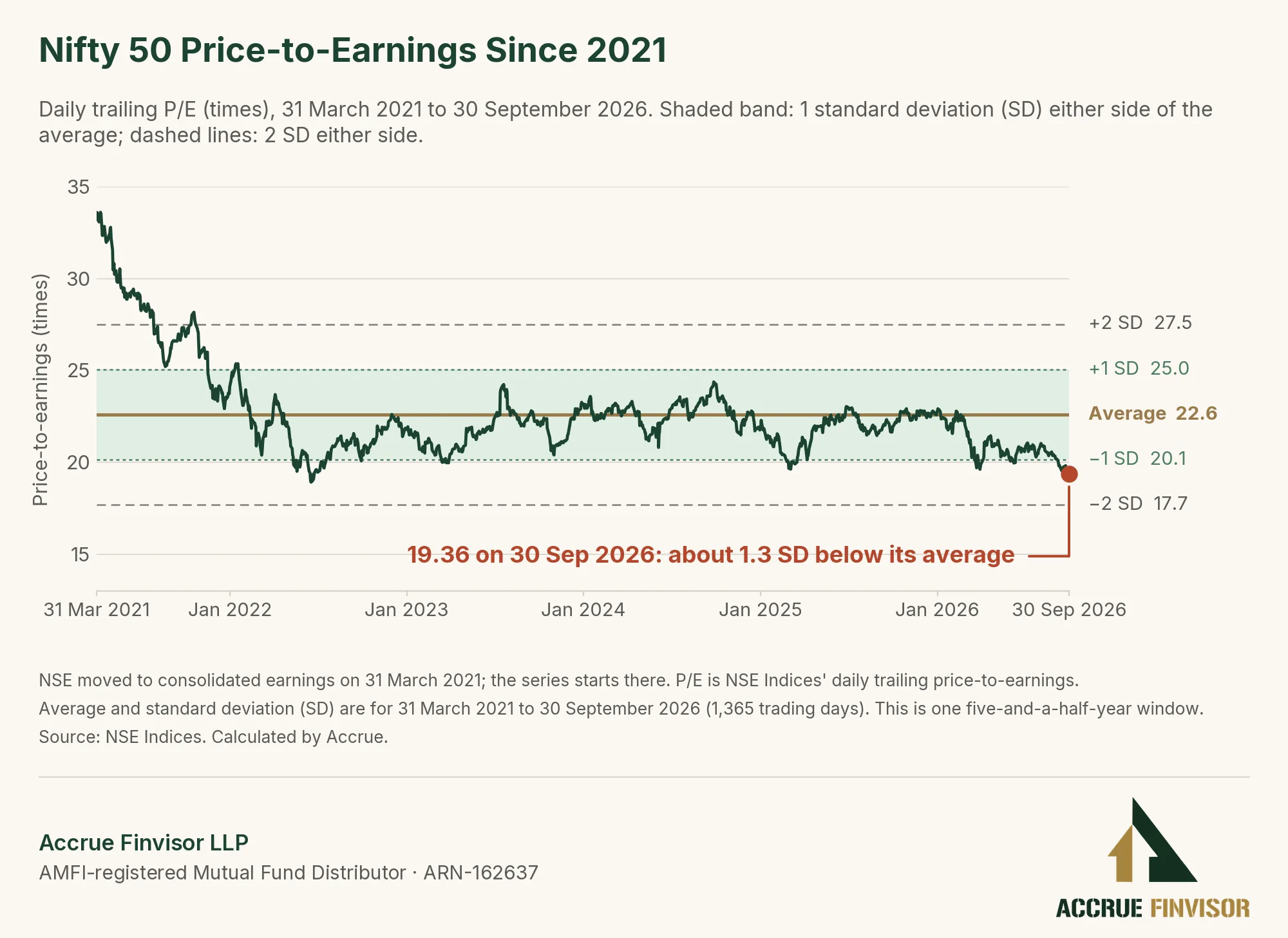
The Nifty 50’s P/E is about 1.3 standard deviations below its average since 2021.
The other side
The Nifty Smallcap 250 trades about one standard deviation above its average P/E since 2021.
The Nifty Smallcap 250’s premium to the Nifty 50 is the widest since 2021, about 2.4 standard deviations above its average.
Over five years, small-cap earnings grew about 59% while the index rose about 90%.
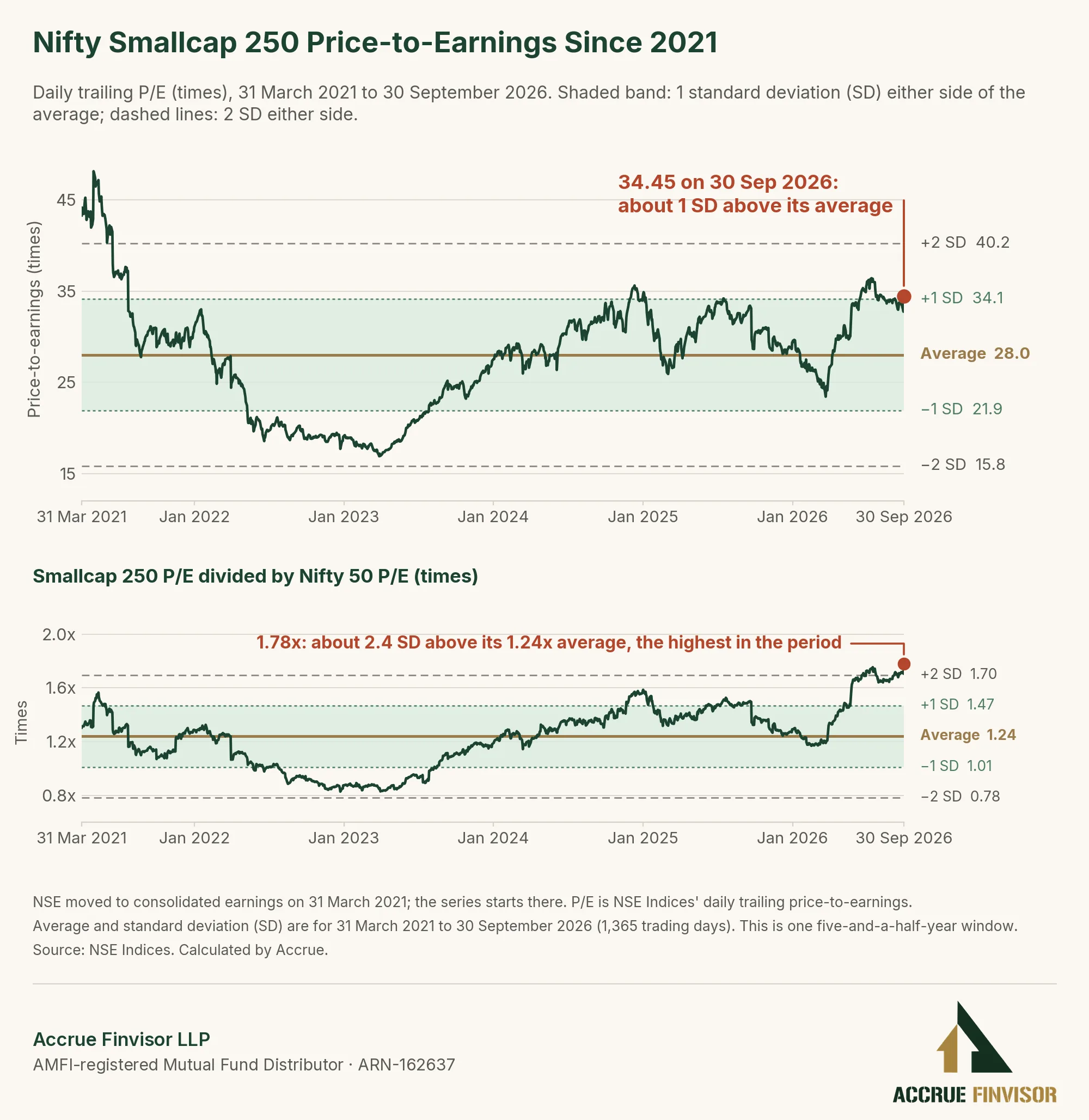
Small caps trade above their post-2021 average P/E, at the widest premium to the Nifty 50 since 2021.
Polarisation Has Happened Before
Indian markets are highly polarised today. That is not unusual.
Polarisation has developed many times in the past, and it will develop again. If one part of your portfolio is doing very well and another very poorly, polarisation is the cause.
Whatever you can rightly say about India’s market today, the opposite is also true. A portfolio that owns both will feel both.

✓ You have finished this 3-minute read
Team Accrue · Accrue Insights
Thank you for reading. We write for investors who want the whole picture, the opportunity and the risk.
This article discusses general market and macroeconomic trends only. It does not recommend, endorse, or provide advice on any specific security, mutual fund scheme, or investment strategy. Companies named are illustrations only, not recommendations. See Accrue's full regulatory disclosures below.
Has the Sensex made money in the last five years?
Not much. Over the five years to September 2026 the Sensex delivered an annual return of just over 4% before dividends, against about 14% for the Midcap 150 and Smallcap 250 and about 21% for the Microcap 250.
Are FIIs selling Indian equities?
Yes. Net FII equity selling reached ₹2.6 lakh crore from January to September 2026, more than in any full year since 2002. Since April 2022, FIIs have sold most in financials, IT and oil and gas and are net buyers of capital goods, telecom and healthcare.
How is the Nifty 50 valued against its history?
At a trailing P/E of about 19.4x at the end of September 2026, the Nifty 50 was 1.3 standard deviations below its post-2021 average. NSE moved to consolidated earnings in March 2021, so earlier readings are on a different basis.
How are small caps valued?
The Nifty Smallcap 250 trades about one standard deviation above its post-2021 average P/E, and its premium to the Nifty 50 is the widest since 2021.
Has the market been polarised before?
Yes. Polarisation has developed many times in the past, and it will develop again.