Is France in a Debt Crisis?
“The time to repair the roof is when the sun is shining.”

For information and education only. Not investment advice, and not research for the purpose of investment.
In September 2026, the yield on France’s ten-year government bond exceeded Germany’s by 97 basis points, the widest monthly average gap since July 2012.
France carries the largest public debt in the euro area by amount. The yield premium comes with persistent deficits and a legislature with no absolute majority.
France’s Debt Problem
France’s borrowing cost has spiked. Its ten-year yield, as a monthly average, jumped 44 basis points in September, a sharper rise than Germany’s. The ten-year spread is how markets price French credit risk: both governments borrow in euros under one central bank, so the spread reflects how lenders judge each of them.
Plot euro-area ten-year yields against credit ratings and the countries broadly line up in order: the better the rating, the less a government pays. France is the clear exception.
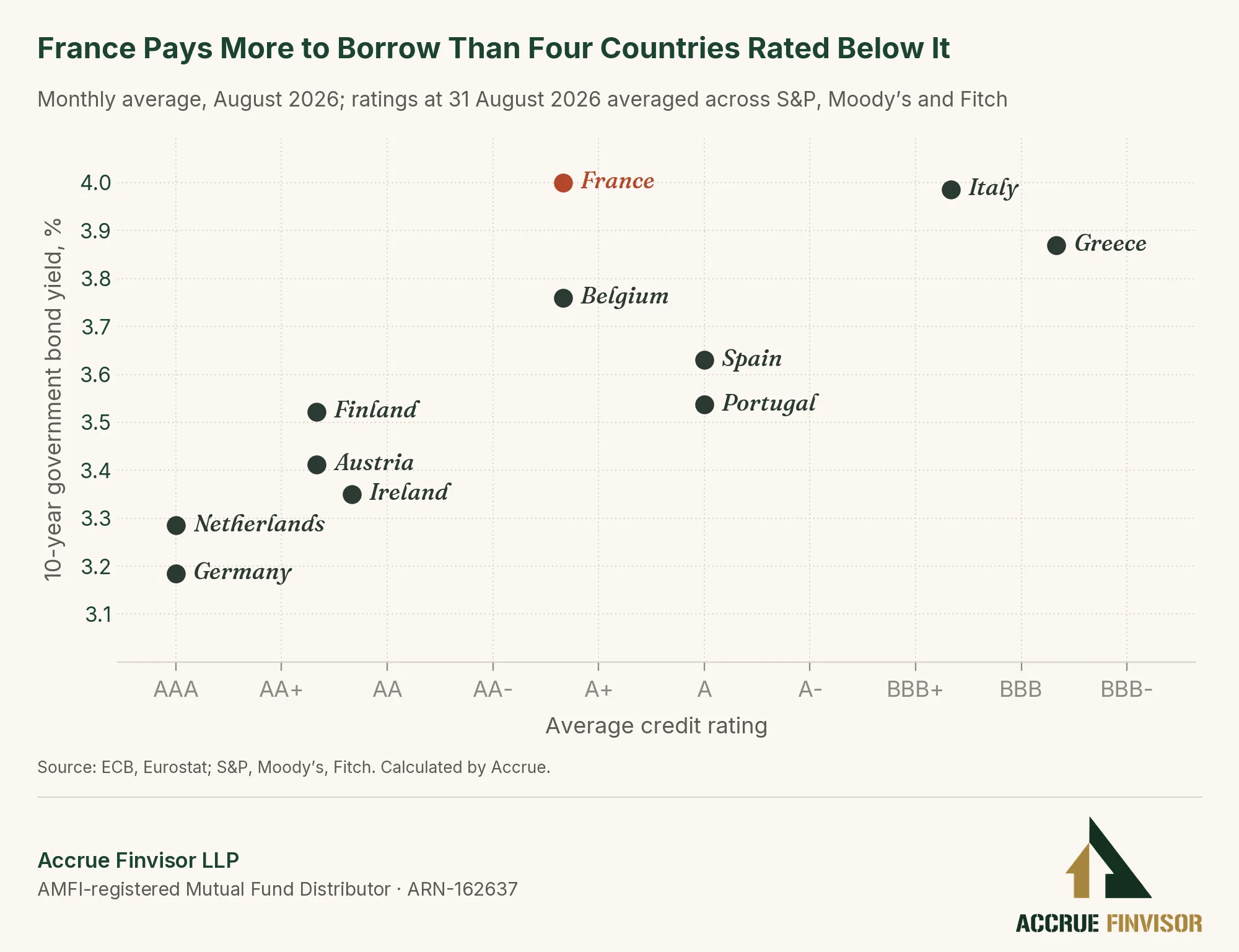
Ten-year government bond yields, monthly average for August 2026, against each country’s average rating from S&P, Moody’s and Fitch at 31 August 2026. France (A+ from S&P, Aa3 from Moody’s, A+ from Fitch) had the highest yield of the eleven, 4.00%. Spain, Portugal, Italy and Greece, which have a lower average rating, had 3.63%, 3.54%, 3.99% and 3.87%.
France is a large economy with a major debt. It is the euro area’s second-largest economy, after Germany. France’s debt stood at 119% of its GDP at the end of June 2026, according to INSEE, France’s statistics office.
France’s public sector spends more than it collects, even before it pays interest on its debt. In 2025 the average interest rate on that debt, 2.02%, moved above nominal GDP growth of 1.90%. Put the two together and the debt grows faster than the income that pays for it.
Yields are rising alongside a massive total debt stock. However, France is not in a debt crisis yet!
Not a Crisis Like 2012
The euro crisis turned on one question: would anyone stand behind the weaker governments? Today there is an answer: the European Central Bank has two backstops. They are Outright Monetary Transactions, created in 2012, and the Transmission Protection Instrument, added in 2022. Neither has ever been used, and both come with conditions on a country’s public finances.
France still finds buyers for its bonds. The euro area’s central banks have stopped buying, and the French public-sector bonds they hold from their purchase programmes are down 28% since the end of 2022.
Investors outside France filled the gap: they held 55.9% of the long-term debt securities issued by French public administrations at the end of March 2026, up from under half at the end of 2021.
The premium is wide by France’s standards, but it is a fraction of what Italy and Spain paid in the euro crisis. Their gaps over Germany, as monthly averages, went above 500 basis points in 2011 and 2012.
What makes France’s debt problem worse is its politics.
The Problem Is Politics!
No French government has had an absolute majority in parliament since June 2022. Without one, every budget depends on parties outside the government. Five prime ministers have held office since then, and the National Assembly censured one government.
Budgets have stalled. The Assembly rejected the first part of the budget bill two years running, and both years ended with special laws just to keep collecting taxes. Meanwhile the deficit was still 5.1% of GDP in 2025, a year in which the economy grew.
Investors now price France next to Italy, not Germany. From 2015 to 2021, before the majority was lost, France’s ten-year yield averaged less than 50 basis points above Germany’s each year. Today France pays as much as Italy to borrow for ten years, though Italy owes more for the size of its economy and has a lower rating from all three major agencies.
S&P downgraded France’s credit rating to A+ in October 2025. The agency told the French Senate that the run of censure motions was liable to hinder fiscal consolidation and policy continuity.
The run-up to the presidential election, due in 2027, adds to the political pressure.
France’s rising borrowing cost is partly an economic problem and partly a political one.

✓ You have finished this 3-minute read
Team Accrue · Accrue Insights
Thank you for reading. We write for investors who want the whole picture, the opportunity and the risk.
This article discusses general market and macroeconomic trends only. It does not recommend, endorse, or provide advice on any specific security, mutual fund scheme, or investment strategy. Companies named are illustrations only, not recommendations. See Accrue's full regulatory disclosures below.
How high is France’s borrowing premium over Germany?
France’s monthly average yield gap over Germany reached 97 basis points in September 2026, its widest margin since July 2012.
How much of France’s debt is held by foreign investors?
Non-resident investors held 55.9% of long-term debt securities issued by French public administrations at the end of March 2026.
Did the European Central Bank reduce its holdings of French bonds?
Yes. The Eurosystem shrank its holdings of French public-sector securities under its two bond-buying programmes by about 28% between the end of 2022 and September 2026.
Is France in a debt crisis like 2012?
No. France’s monthly average yield gap over Germany was 97 basis points in September 2026, a fraction of the monthly average gaps of more than 500 basis points that Italy and Spain paid in 2011 and 2012. The European Central Bank also now has two backstops, neither of which has been used.
Did S&P downgrade France’s credit rating?
Yes. S&P downgraded France’s credit rating to A+ in October 2025.

Read next
What Record Global Debt Means for Investors
How governments built a record burden, and who ultimately absorbs the cost
Read the article →Sources (23)
- ECB Data Portal — long-term interest rate for convergence purposes (dataset IRS): ten-year government bond yields, monthly average of daily data, France, Germany, Italy, Spain and seven other euro-area countries, January 2008 to August 2026; downloaded 10 October 2026.
- Eurostat — EMU convergence criterion bond yields, monthly (irt_lt_mcby_m), France and Germany, January 2008 to August 2026, updated 11 September 2026; cross-check of the ECB series; yearly averages of the France-Germany gap, 2015 to 2021, are Accrue’s calculations.
- Banco de España — Boletín Estadístico, table 26.36, ten-year government bond yields, monthly average of daily figures, August and September 2026 (September 2026: France 4.44%, Germany 3.47%); downloaded 10 October 2026.
- S&P Global Ratings, Moody’s and Fitch Ratings — long-term foreign-currency sovereign ratings of the eleven countries at 31 August 2026, from each agency’s rating announcements. France: S&P A+ (cut from AA- on 17 October 2025), Moody’s Aa3 (affirmed 10 April 2026), Fitch A+ (affirmed 28 August 2026).
- INSEE — public debt at the end of the second quarter of 2026, 29 September 2026.
- INSEE — public deficit and debt in 2025, 27 March 2026.
- Eurostat — government deficit, interest paid, debt and GDP, France, 2008 to 2025, and Italy’s debt as a share of GDP, 2025 (gov_10dd_edpt1, gov_10a_main, nama_10_gdp), updated 22 April, 21 July and 9 October 2026; primary deficit and the average interest rate on debt are Accrue’s calculations.
- Eurostat — GDP at current prices, euro-area countries, 2025 (nama_10_gdp), updated 7 October 2026: France second after Germany.
- Eurostat — quarterly government debt in euros, euro-area countries (gov_10q_ggdebt), first quarter of 2026, updated 21 July 2026.
- ECB — The Transmission Protection Instrument, 21 July 2022.
- ECB Occasional Paper 372 (2025, staff paper): neither OMTs nor the TPI have been activated to date.
- ECB — Eurosystem holdings of French public-sector securities under the PSPP and the PEPP, monthly tables updated 6 October 2026; running sums by Accrue.
- Banque de France — Émission et détention de titres français, first quarter of 2026, published 13 July 2026 (non-residents’ share of long-term debt securities issued by French public administrations).
- Assemblée nationale — membership of the political groups, 17th legislature, consulted 8 October 2026.
- Légifrance — decrees appointing the Prime Minister: Borne (16 May 2022), Attal (9 January 2024), Barnier (5 September 2024), Bayrou (13 December 2024), Lecornu (9 September 2025).
- Assemblée nationale — scrutin no 519, adoption of the motion of censure against the Barnier government, 4 December 2024.
- Assemblée nationale — scrutins no 438 (12 November 2024) and no 4241 (21 November 2025), rejection of the first part of the finance bill; Sénat — list of laws promulgated in 2025, special law 2025-1316 (26 December 2025).
- Sénat — list of laws promulgated in 2024, special law 2024-1188 (20 December 2024).
- Sénat — rapport général no 139 (2025-2026), tome III, annexe 12, Engagements financiers de l’État (S&P’s written reply to the rapporteur).
- ECB — technical features of Outright Monetary Transactions, 6 September 2012.
- ECB — Eurosystem holdings of French public-sector securities under the PEPP, monthly table updated 6 October 2026; running sums by Accrue.
- Ministère de l’Intérieur — résultats définitifs des élections législatives des 12 et 19 juin 2022 (data.gouv.fr).
- Service-public.fr — presidential election of 18 April and 2 May 2027, published 2 July 2026.