
Why Is China's Stock Market Falling? The 12-Week Fall Explained, and What It Means for India
“When you know a thing, to hold that you know it; and when you do not know a thing, to allow that you do not know it;—this is knowledge.”

China's main stock index fell 12 weeks in a row to 30 October, for the first time in the 21 years since the index began. A new tax, a sell-off in technology stocks and lower profit forecasts are behind it. Here is the story, whether Beijing will step in, and what it means for India, whose Nifty 50 just had its own 8-week losing run.
For information and education only. This is not research or investment advice.
Three pressures have hit China's stock market in the same few months:
- A new tax on offshore trusts that, Reuters reported, pushed some of China's richest families to raise cash.
- Technology stocks have been hit hard. China's tech-heavy STAR 50 index has lost almost half its value since its peak at the end of June.
- Profit forecasts have been cut.
Press reports and analysts say state-linked funds have been buying index ETFs since mid-October. The market has kept falling anyway.
For India: the Nifty 50 fell eight weeks in a row, from mid-August to 1 October, its longest losing run since 2001, and foreign investors sold a net ₹2.95 lakh crore of Indian shares so far in 2026 (to 30 October), the most in NSDL data going back to 2002.
How bad is the fall in Chinese stocks?
The CSI 300—tracking the 300 largest companies listed in Shanghai and Shenzhen—has closed lower for 12 consecutive weeks to 30 October 2026. This is the longest losing streak since the index launched in 2005.
The index is down 21% from its 22 June peak, crossing into bear market territory, Reuters reported. Its 8.5% drop in October marked its steepest monthly loss in over a decade, according to Reuters.
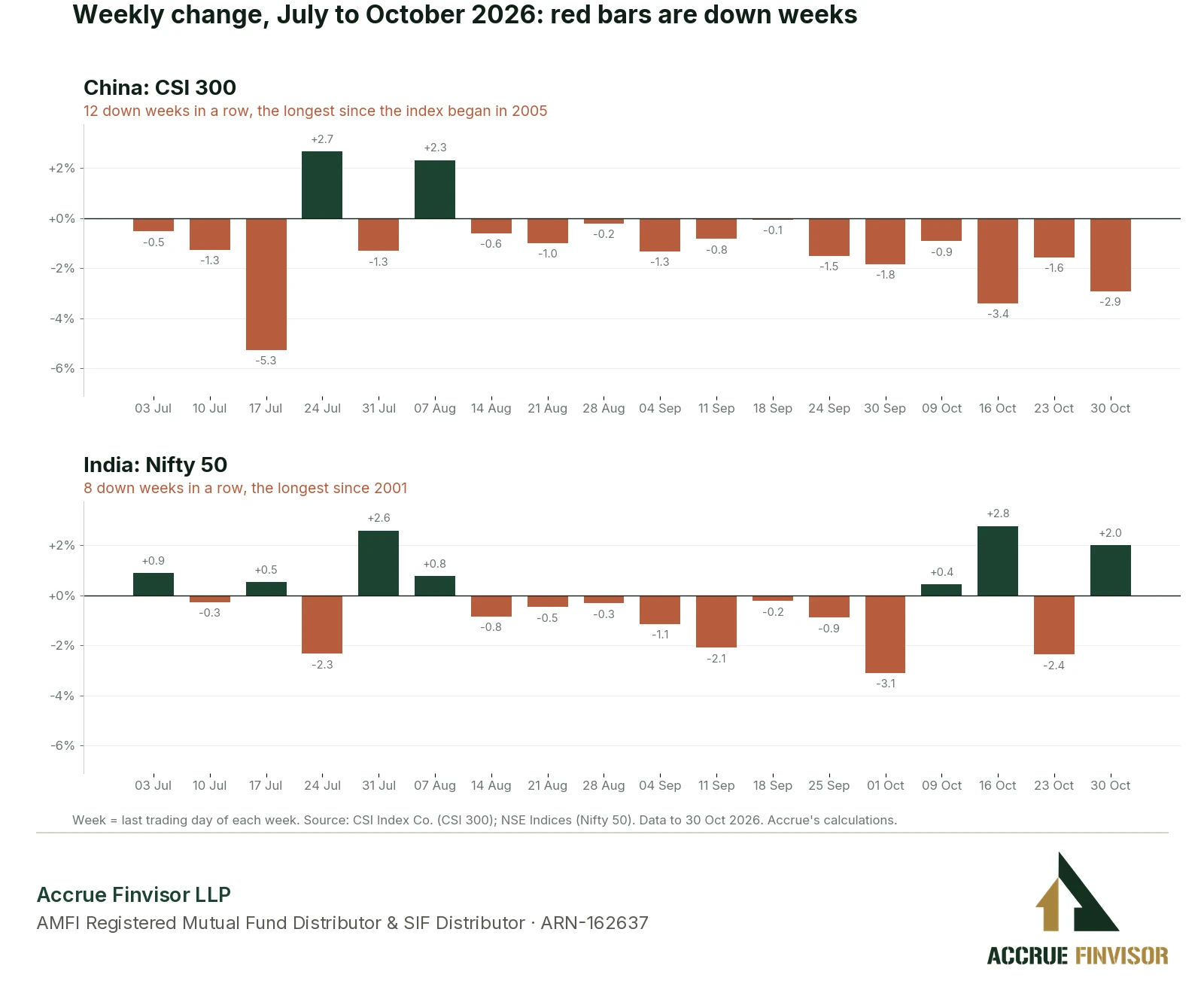
Weekly change in the CSI 300 and the Nifty 50, July to October 2026. A week ends on its last trading day. Source: CSI Index Co.; NSE Indices. Accrue's calculations.
A record fall does not by itself make shares cheap. The CSI 300's trailing price-to-earnings ratio, 12.7 on 29 October, is close to its own average since 2011. And over the long run, even with dividends reinvested, the index is back near where it stood at its October 2007 peak.
The CSI 300 plays a similar role for China as the Nifty 500 does for India: a broad gauge of the big companies listed at home.
Did every Chinese index fall the same way?
No. Chinese stocks are listed in several markets, and they have not fallen by the same amount.
The record losing streak belongs to the mainland market. Tencent and Alibaba, the names most familiar to Indian investors, are absent from the CSI 300. They are listed in Hong Kong and feature in the MSCI China, where together they account for nearly a quarter of the index.
Why is China's stock market falling? Three pressures
There is no single catalyst. A new tax, a sharp technology sell-off, and reduced earnings forecasts converged within a few months.
1. China's tax on offshore trusts
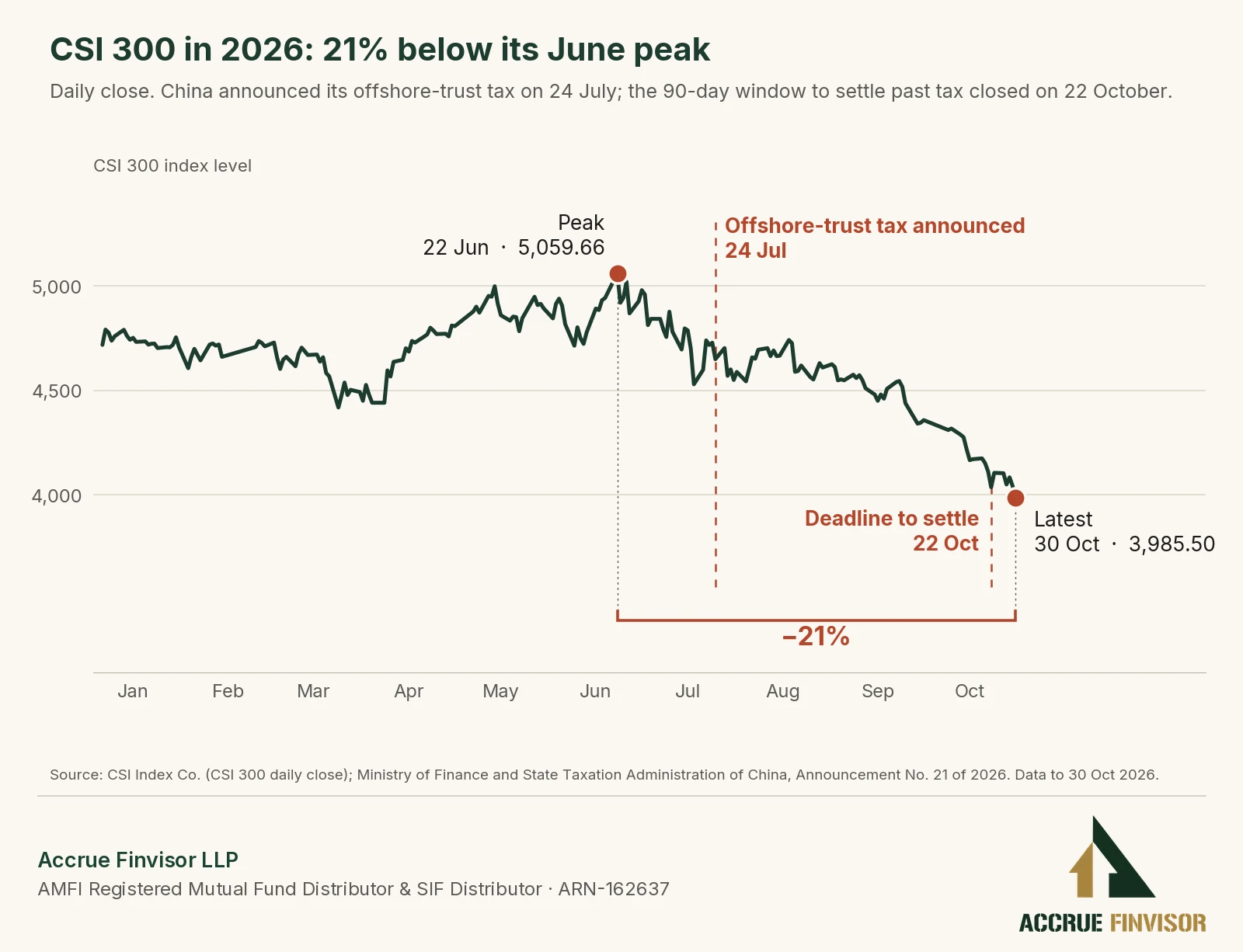
CSI 300 daily close, January to 30 October 2026. Source: CSI Index Co.; Ministry of Finance and State Taxation Administration of China, Announcement No. 21 of 2026.
For years, many founders of Chinese companies listed in Hong Kong and New York held their equity through offshore family trusts.
On 24 July 2026, China issued Announcement No. 21. It requires Chinese tax residents to pay tax on the gain made when shares were moved into an offshore trust, and on the income those trusts earn. China's personal income tax rate on such gains is 20%.
The complication lies in the calculation: the gain is based on the share value on the transfer date, minus the founder's acquisition cost. Current market prices are irrelevant.
Taxpayers had a 90-day window to settle past liabilities without late fees. That window closed on 22 October 2026.
Some families had to raise cash. Reuters ran the headline on 16 October: "China's super-rich scramble to exit offshore trusts, raise cash as taxman knocks". In September, a family trust tied to Haidilao's founder sold roughly US$350 million in shares, sinking the stock, according to Bloomberg. Bloomberg also reported on 19 October that eight Chinese billionaires could fall under this broader tax net.
The CSI 300 was already 8% below its June peak when the notice came, and fell a further 14% afterwards, straight through the deadline.
Not everyone sees the tax as the main cause. Most affected founders listed their companies in Hong Kong or New York, outside the CSI 300. BofA's China equity strategist Winni Wu said the tax was unlikely to be a dominant driver for the Hong Kong market, Reuters reported on 22 September. It serves as one pressure point among several.
2. Technology stocks have been hit hard
China's tech-heavy STAR 50 index surged roughly 75% between April and June, only to drop nearly 40% by 17 October, Bloomberg reported. By 30 October it was about 47% below its 30 June closing peak.
AI-related stocks carry enough weight to move the broader market. Goldman Sachs estimated in October that AI-related stocks represent 42% of the market capitalization and 57% of trading volume across China's A-shares and Hong Kong's H-shares, Reuters reported.
Chinese equities bore the brunt of a stumbling global AI trade, Bloomberg reported. Foreign investors withdrew an estimated CNY 90 billion from mainland Chinese shares via the Stock Connect link between July and September. This marked the heaviest outflow in a year, according to Bloomberg.
3. Profit forecasts have been cut
Consensus 2026 earnings forecasts for MSCI China constituents have fallen by more than 4% since the end of March, Bloomberg data indicate. For the Hang Seng Tech index, which Bloomberg describes as dominated by internet firms mired in e-commerce price wars, the cut exceeds 13%.
Price wars are one reason analysts give. "Competition is encouraged and generally brutal in China, not shareholder friendly," Jason Lemire of Bold Wealth Partners told Bloomberg.
Official data look better, but the gains are narrow. Profits at China's larger industrial firms rose 15.5% in January to September, the National Bureau of Statistics said on 27 October, mostly in electronics, on demand for AI chips, and in raw materials. "Outside these segments, the broader corporate sector continued to struggle," Eric Zhu, an analyst quoted by Bloomberg, said, pointing to weak demand at home and intense price competition.
Is the Chinese government buying stocks?
Analysts and media reports suggest they are. Exchange data reveal significant buying of index ETFs starting mid-October, which analysts attribute to state-linked funds. No official body has confirmed the October interventions.
Analysts estimated state-linked funds put up to CNY 170 billion into the market during October, the South China Morning Post reported.
Yet the market continued to slide. "We see limited motivation for a prolonged intervention campaign," Patrick Pan of Bank of America told the South China Morning Post on 28 October, noting that China is not the only market hit by the global AI sell-off.
China's onshore markets have historically tended to bottom one to two months after state buying and pledges from top regulators to stabilise stocks, Morgan Stanley said, the South China Morning Post reported on 27 October. The same report said offshore-listed Chinese stocks could fall a further 10% to 15% before bottoming. That is the bank's view, not ours.
Will Beijing stimulate before the 2027 Party Congress?
So far Beijing has taken smaller steps than in 2024, and nobody knows whether more is coming.
Update, 2 November: Chinese media reported that the People's Bank of China and the banking and securities regulators would meet major banks, and separately some securities firms and fund managers, on 2 November to discuss improving the CNY 300 billion facility that lends money for share buybacks. No outcome had been announced at the time of writing. The CSI 300 rose about 0.8% that day, index data feeds show. China's NPC Standing Committee meets from 2 to 6 November; its published agenda has no budget item.
The precedent exists. On 24 September 2024, the People's Bank of China announced cuts to interest rates and set up a CNY 500 billion facility for brokers, funds, and insurers to purchase equities, plus up to CNY 300 billion of loans for share buybacks. The CSI 300 rallied 32.5% between 23 September and 8 October 2024, then gave back part of that gain in the following weeks. Past performance does not indicate future returns.
Recent actions have been more restrained. Policymakers "opted for incremental measures rather than the substantial packages seen in 2024", RBC Wealth Management noted, as reported by Reuters. Stronger-than-expected growth in July to September further reduced expectations of more policy support, Reuters reported on 22 October.
The next major milestone is political. The Communist Party leadership convened in late October, setting the 21st National Party Congress for the second half of 2027. Whether a 2024-style package materializes before then is the open question. We make no forecast.
Does China's fall affect India? The Nifty fell 8 weeks in a row too
India's Nifty 50 also fell eight weeks in a row, from mid-August to 1 October 2026, its longest weekly losing streak since 2001.
Notably, the losing streaks in China and India started in the exact same week. India's streak ended after the week to 1 October; China's was still unbroken at the 30 October close.
India's drawdown was protracted but shallow. The Nifty 50 shed approximately 9% over its eight-week run. China's 12-week run cost it 15%, compounding losses already accumulated since June.
India has lost foreign money too. Foreign investors sold a net ₹2.95 lakh crore of Indian equities in 2026 through 30 October, according to NSDL data. This is the highest calendar-year outflow since NSDL records began in 2002. How that selling has played out at home is covered in our pieces on India's growing economy and sliding markets and how polarised India's stock market has become.
Regional performance data groups the two markets together. "Together with Indonesia and India, stocks in China have emerged as the worst performers in the region this year," CNN's John Liu wrote on 30 October.
We read it this way: the AI build-out has become the strongest magnet for capital in the financial system, pulling money towards a handful of companies, and divergence this stark tends to come with a technology transition.
Frequently asked questions
Why is China's stock market falling?
Three pressures landed in the same months of 2026: a new tax on gains in offshore trusts that, Reuters reported, pushed some wealthy families to raise cash; a sharp fall in technology stocks, with the tech-heavy STAR 50 index down about 47% from its June peak by 30 October; and cuts to profit forecasts.
Is China's stock market crashing?
China's main index is in a bear market, usually defined as a fall of 20% or more from a peak. The CSI 300 crossed that line on 22 October 2026, Reuters reported, and closed 21% below its June peak on 30 October after a record 12 straight weekly falls.
Is the Chinese government buying stocks to stop the fall?
Analysts and press reports say yes. Exchange data show heavy buying of major index ETFs in Shanghai and Shenzhen from mid-October 2026. Analysts' estimates of state-linked buying in October range from more than CNY 110 billion (Bank of America) to about CNY 170 billion (Goldman Sachs), the South China Morning Post reported. No official body has confirmed the October buying.
Will China's stock market recover?
No one can say, and this is not a forecast. China's onshore markets have historically tended to bottom one to two months after state buying and pledges from top regulators to stabilise stocks, Morgan Stanley said, the South China Morning Post reported on 27 October 2026. Past performance does not indicate future returns.
Did the Nifty also fall for 8 weeks in a row?
Yes. India's Nifty 50 fell for eight straight weeks, from the week ending 14 August to the week ending 1 October 2026, losing about 9%. It was the index's longest weekly losing streak since 2001, when it fell nine weeks in a row.
More questions (8)
How long has China's stock market been falling?
The CSI 300, China's main index of its 300 largest mainland-listed companies, fell for 12 weeks in a row from the week ending 14 August to the week ending 30 October 2026. That is its longest weekly losing streak since the index began in 2005. The previous record was nine weeks, ending in January 2012.
What is the CSI 300 index?
The CSI 300 tracks the 300 largest and most traded companies listed on the Shanghai and Shenzhen stock exchanges, priced in yuan. It began in 2005 and is China's main benchmark for its home stock market. It does not include Hong Kong-listed giants such as Tencent and Alibaba.
How much has the CSI 300 fallen in 2026?
The CSI 300 closed at 3,986 on 30 October 2026. That is 21% below its peak of 5,060 on 22 June 2026 and 13.9% lower than at the end of 2025.
How much have Chinese technology stocks fallen?
China's tech-heavy STAR 50 index rose about 75% from April to June 2026, Bloomberg reported. On 30 October it closed about 47% below its closing peak of 30 June. AI-related stocks make up 42% of the value of China's A-shares and Hong Kong's H-shares, Goldman Sachs estimated in October.
What is China's offshore trust tax?
On 24 July 2026, China's Ministry of Finance and State Taxation Administration issued Announcement No. 21. It asks Chinese tax residents to pay tax, at 20%, on gains made when shares were moved into offshore trusts, and on income those trusts earn. Past tax could be paid without a late fee until 22 October 2026.
Will China stimulate its economy before the 2027 Party Congress?
No one knows. In September 2024 Beijing announced rate cuts and facilities worth up to CNY 800 billion to support share buying; the CSI 300 rose 32.5% in the following two weeks, then gave back part of that gain. In 2026 policymakers have so far chosen smaller steps. The Communist Party has set its 21st National Party Congress for the second half of 2027.
How does China's stock market fall affect Indian investors?
Directly, only if they hold Chinese or Hong Kong shares through international funds, GIFT City funds or investments abroad under the RBI's Liberalised Remittance Scheme. Indian markets had their own pressure in 2026: foreign investors sold a net ₹2.95 lakh crore of Indian shares up to 30 October, the most in any year in NSDL data from 2002.
Can Indians invest in the Chinese stock market?
Yes, through India-listed international mutual funds and ETFs that hold Chinese or Hong Kong shares, funds in GIFT City, or by investing abroad under the RBI's Liberalised Remittance Scheme. Each route has its own limits, costs and tax rules, and some routes may be closed to fresh money at times.
Sources and data (34)
- CSI Index Co. — CSI 300 daily close (Jan 2005 to 30 Oct 2026) and trailing P/E (28 Jun 2011 to 29 Oct 2026); weekly runs and P/E average are Accrue's calculations
- NSE Indices — Nifty 50 and Nifty 500 daily closes to 30 Oct 2026; weekly runs are Accrue's calculations
- NSDL — FPI net investment, equity, calendar years 2002 to 2026 (to 30 Oct 2026)
- Reserve Bank of India — FAQs on the Liberalised Remittance Scheme (US$250,000 limit)
- Ministry of Finance and State Taxation Administration of China — Announcement No. 21 of 2026 on individual income tax on offshore trusts, 24 Jul 2026
- Individual Income Tax Law of the People's Republic of China, Article 3 (20% rate)
- Reuters, 16 Oct 2026 — China's super-rich scramble to exit offshore trusts, raise cash as taxman knocks (via The Standard, Hong Kong)
- Reuters, 22 Sep 2026 — China's offshore trust tax crackdown could impact single stocks, BofA says
- Bloomberg, 9 Sep 2026 — Haidilao billionaire's $350 million surprise sale sinks shares
- Bloomberg, 19 Oct 2026 — Chinese tycoons with $140 billion overseas face wider tax net (via The Standard, Hong Kong: "China's offshore trust tax push hits Xiaomi founder, 7 more billionaires")
- Bloomberg, 17 Oct 2026 — Chinese stocks turn biggest losers as global AI trade stumbles (via The Edge Malaysia)
- Bloomberg, 25 Oct 2026 — Sinking profits turn China's $3.5 trillion stock rout into trap (also carried by The Star, 26 Oct)
- Shanghai and Shenzhen stock exchanges — ETF shares outstanding, daily; net creation is Accrue's calculation
- South China Morning Post, 28 Oct 2026 — China's stock slide can't be reversed by massive state buying, analysts warn
- Bloomberg, 26 Oct 2026 — Morgan Stanley sees further China stock downside before bottom (via Bloomberg Línea)
- Reuters, 22 Oct 2026 — China blue-chip index confirms bear market as AI stocks slump; comments by Hao Hong and Zeng Wenkai (via Devdiscourse)
- Reuters, 26 Oct 2026 — Goldman Sachs estimate of AI-related stocks' share of value and trading (via Moneycontrol)
- CNN, 30 Oct 2026 — Why isn't China's AI and tech boom saving its stock markets? (John Liu)
- Reuters, 30 Oct 2026 — China stocks post biggest monthly loss on AI selloff (via Business Recorder)
- Communiqué of the Fifth Plenary Session of the 20th CPC Central Committee, 29 Oct 2026 (Chinese foreign ministry, English text)
- STAR 50 index closes: 30 Jun 2026 peak 2,207.86; 30 Oct 2026 close 1,160.84 (Xinhua, 30 Oct 2026); Accrue calculation
- Reuters, 24 Sep 2024 — factbox on the People's Bank of China stimulus package: rate and RRR cuts, CNY 500bn swap facility, CNY 300bn buyback relending (via Investing.com)
- Reuters, 24 Oct 2026 — RBC Wealth Management on incremental measures vs 2024 packages (via Business Recorder)
- Xinhua, 19 Oct 2026 — China's GDP grew 4.5% in Q3 2026
- CSI 300 closes 23 Sep 2024 (3,212.76), 30 Sep 2024 (+8.48%), 8 Oct 2024 (4,256.10): CSI Index Co.; Accrue calculation
- Accrue analysis of CSI Index Co. and Shanghai/Shenzhen exchange data: CSI 300 trailing earnings (June peak to 29 Oct 2026), STAR 50 fall from its 30 Jun 2026 closing peak, and net creation of major index ETFs (30 Sep-30 Oct 2026; Shenzhen part estimated)
- CSI Index Co. — CSI 300 Total Return Index (H00300) daily closes: 16 Oct 2007 6,028.42; first close above it 5 Jun 2015; high 7,567.55 on 10 Feb 2021; 30 Oct 2026 6,001.14
- South China Morning Post, 27 Oct 2026 — China stock sell-off could erase another 15% in value, Morgan Stanley says (Laura Wang on bottoms after state buying)
- National Bureau of Statistics of China, 27 Oct 2026 — profits of industrial enterprises above designated size, January-September 2026 (interpretation by Yu Weining)
- Bloomberg, 27 Oct 2026 — China's industrial profits surge most in 3 months on oil; Eric Zhu (via BusinessMirror)
- Bloomberg, 25 Oct 2026 — Jason Lemire quote (via Yahoo Finance Singapore)
- Shanghai Securities News, Securities Times, Cailian and others, 1-2 Nov 2026 — reports of PBOC, NFRA and CSRC meetings on the share-buyback relending facility (2 Nov 2026)
- Xinhua, 22 Oct 2026 — agenda of the 25th session of the 14th NPC Standing Committee, 2-6 Nov 2026
- CSI 300 close 2 Nov 2026: 4,016.92 (+0.79%), index data feeds (Sina, Tencent); CSI Index Co. daily table not yet published at the time of writing
This article discusses general market trends for education only. It does not recommend, endorse or advise on any security, index, fund or strategy, and it is not a forecast. Companies and indices named are for illustration only. Index levels are price indices unless stated; the 2007 comparison uses CSI's total return index. Past performance does not indicate future returns. Last updated: 2 November 2026.